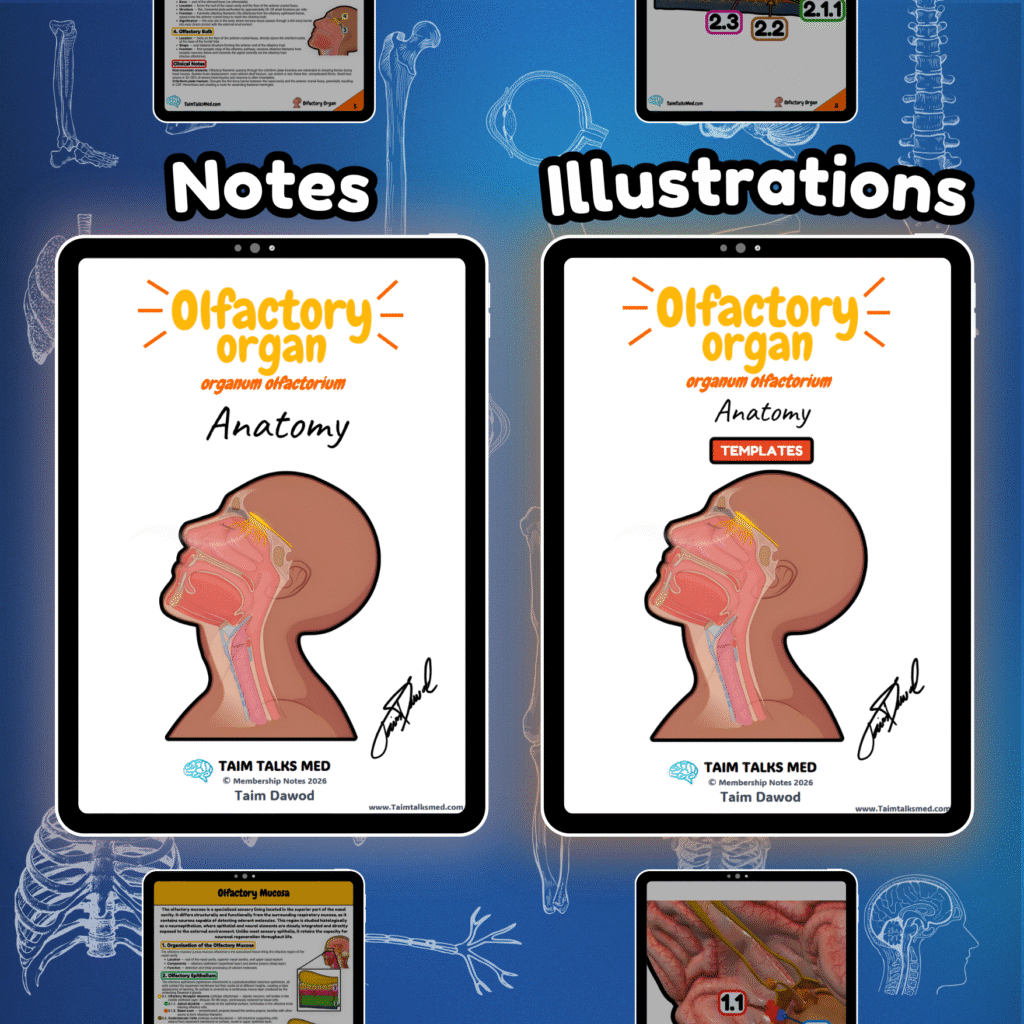
Olfactory Organ

📅 Last Updated: 05.05.2026
🔄 Version: 1.0

This PDF covers the anatomy of the olfactory organ, including the olfactory region of the nasal cavity, olfactory epithelium, receptor neurons, and supporting cells. It explains odorant receptor organization, signal transduction, and the pathway from olfactory filaments through the cribriform plate to the olfactory bulb and cortex.

Central connections to limbic structures, olfactory coding, and clinical conditions such as anosmia and post-traumatic injury are presented in a clear visual format for understanding olfactory anatomy.

Need it offline? Open PDF → Click the three-dot menu → Download PDF.

📖 Sources:

  • Shaikh, F. H., Shumway, K. R., & Soni, A. (2023). Physiology, Taste. StatPearls Publishing
  • Taruno, A., & Gordon, M. D. (2023). Molecular and Cellular Mechanisms of Salt Taste. Annual Review of Physiology, 85, 25–45
  • Buck, L., & Axel, R. (1991). A novel multigene family may encode odorant receptors. Cell
  • Bushdid, C., Magnasco, M. O., Vosshall, L. B., & Keller, A. (2014). Humans can discriminate more than 1 trillion odors. Science
  • Mori, K., Sakano, H., & others. Olfactory coding and receptor organization. NCBI Bookshelf